How did you like the article? Feel free to use our new rating feature on the right edge of the screen and let us know what you think! This will help us improve our content.
Participation is voluntary and anonymous.

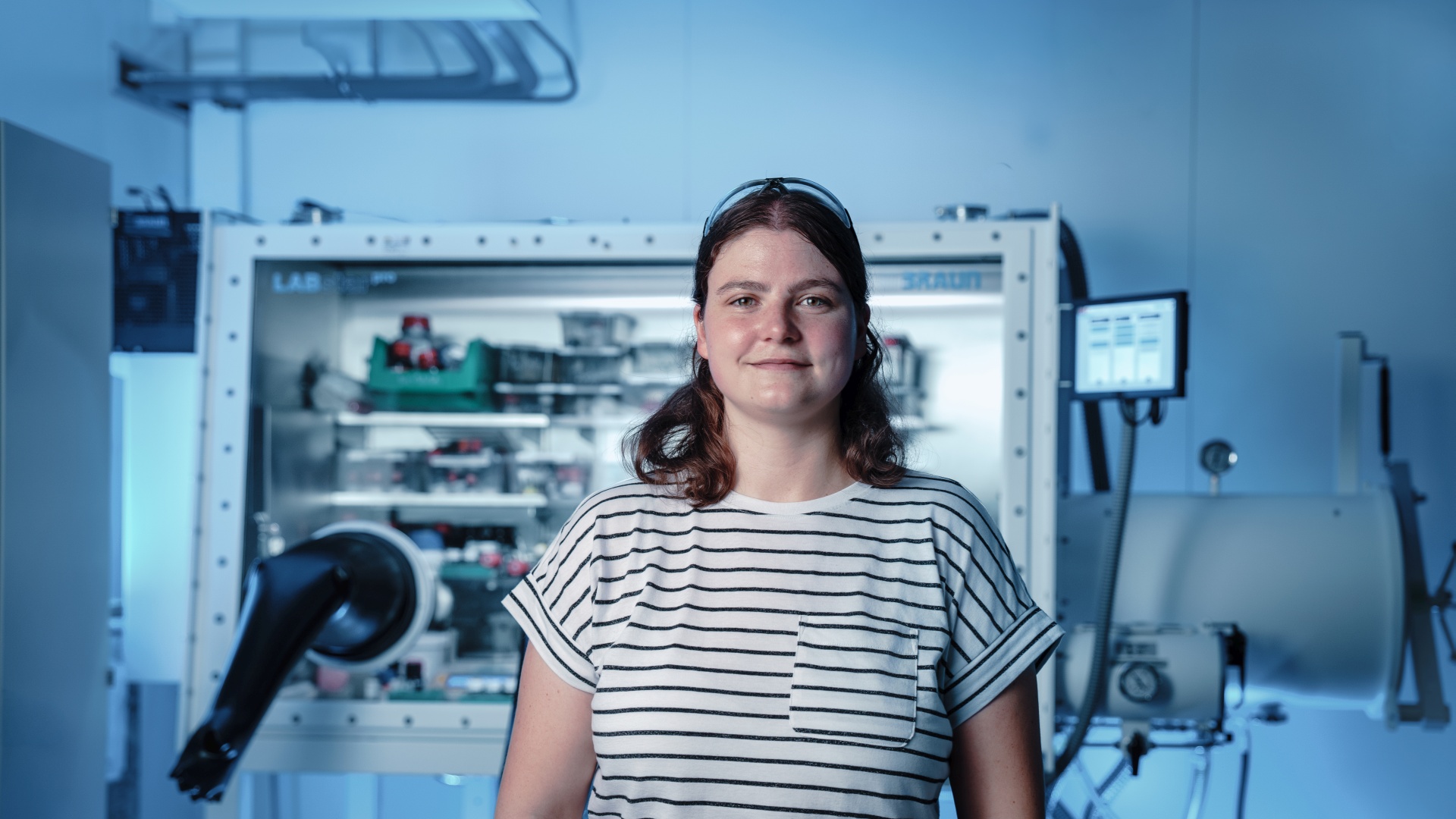
Some researchers spend an entire lifetime conducting research and never publish a scientific paper as first author. Luise Kink succeeded, as a regular master’s student at KIT at just 25 years of age. She explains how it happened in clicKIT.
“I was very pleased to publish our results, but I didn’t realize it was so rare,” says Luise Kink, who is still surprised by it today as she sits behind her desk at KIT’s Institute of Nanotechnology. In the spring of 2026, the master’s student not only published a paper but also succeeded in publishing it as the first author in the prestigious Journal of the American Chemical Society. For many, this represents the crowning achievement of a research career. For Luise, it is likely only the beginning.
How did you like the article? Feel free to use our new rating feature on the right edge of the screen and let us know what you think! This will help us improve our content.
Participation is voluntary and anonymous.
The reason for this early success lies in her openness. During her studies, she wanted to explore all areas of chemistry in order to find out which one she liked best. During her bachelor’s degree, she therefore worked in organic chemistry, completed a master’s module in physical chemistry, and eventually joined Oliver Townrow’s research group to get a taste of inorganic chemistry as a student research assistant. “The project showed so much promise that we decided to turn the student assistant position into a master’s thesis,” Luise recalls.
The goal was to develop a new catalyst based on iron(I) that functions without expensive and rare precious metals and without highly toxic reducing agents. The Roman numeral describes the metal’s electronic state. In chemical compounds, iron is usually present as iron(II) or iron(III). For certain catalytic reactions, however, iron(I) is particularly suitable because it can accept or donate electrons more easily.
“My supervisor, Oliver Townrow, had already stabilized iron(I) against air and water,” explains Luise. “But we still needed to test which organic molecules it reacts well with without the compound decomposing.” After many hours spent immersed in literature research and standing at the glovebox with her arms inserted into thick black rubber gloves, Luise succeeded: she became the first person in the world to demonstrate the functionality of this new air-stable iron(I) source and its catalytic properties. In the long term, iron could make it possible to replace precious metals in certain chemical reactions.
And what comes after this breakthrough? “That was incredibly enjoyable. Oliver Townrow supported me tremendously and gave me a great deal of freedom. I owe it to him that I am listed as the first author on the paper. But I think I would like to return to physical chemistry for my Ph.D.,” says Luise. “It requires more engagement with fundamental principles and less experimentation.” She is also interested in electrochemistry, for example in the field of battery research.
To pursue this path, the student from Freising in Bavaria would like to remain at KIT. She appreciates the relaxed atmosphere in Karlsruhe, the excellent integration of research and teaching, and the wide range of options available in chemistry. “And my roommate and I have lots of zucchini plants and our cat Muk. So I can’t move away anyway,” she says with a smile.
Isabelle Hartmann, September 3, 2026