How did you like the article? Feel free to use our new rating feature on the right edge of the screen and let us know what you think! This will help us improve our content.
Participation is voluntary and anonymous.

For the first time, KIT students are participating in the world’s largest competition in synthetic biology: iGEM (International Genetically Engineered Machine). Around 400 teams compete in this event every year. In clicKIT, Karoline, Friederike, and Thomas explain why they’re participating and why iGEM is much more than a traditional competition.
How did you like the article? Feel free to use our new rating feature on the right edge of the screen and let us know what you think! This will help us improve our content.
Participation is voluntary and anonymous.
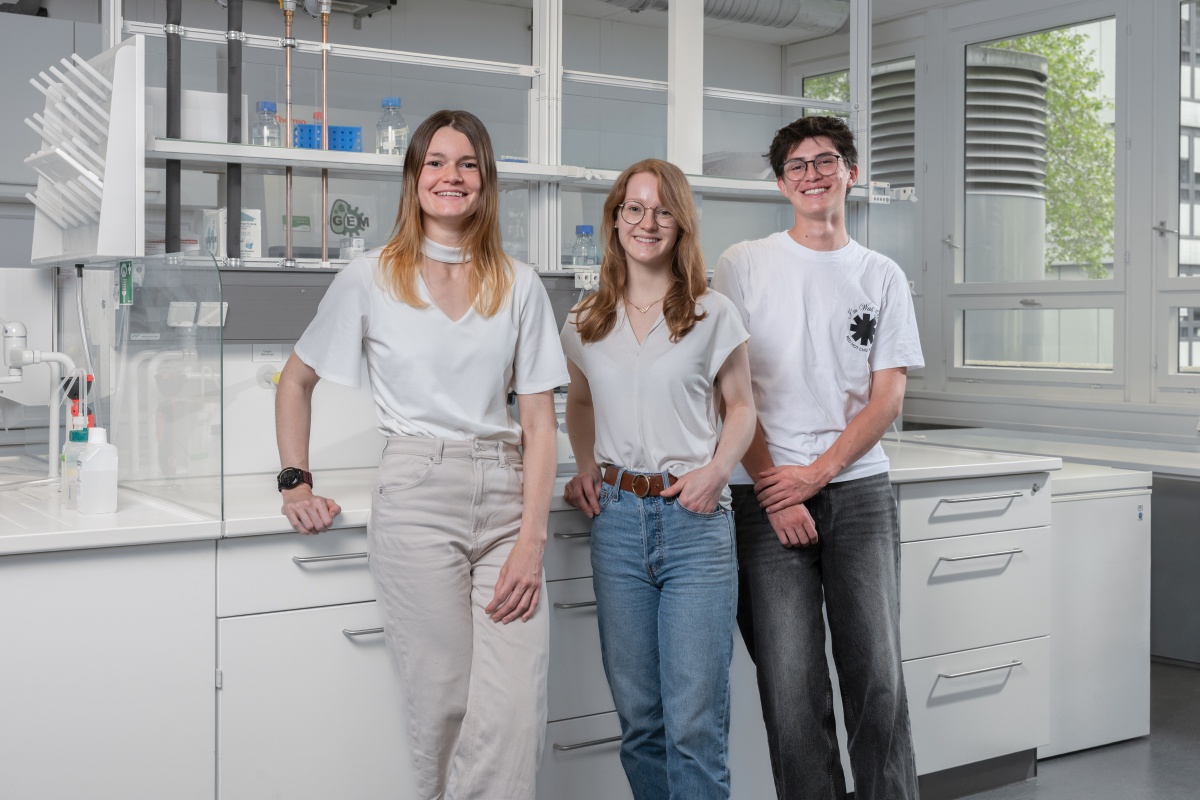
The team brings together students from different fields of study: “Because we are such a diverse group, we learn a lot from each other and support one another,” says Friederike, who is in her sixth semester of a bachelor’s program in bioengineering. Karoline is nearing the end of her master’s degree in biology, and Thomas is in his second semester of a bachelor’s program in chemical biology. “I was unsure at the time about participating in such a large project as a freshman,” Thomas explains. “At the same time, I was interested in how undergraduate and graduate students work together and how we can share our expertise with one another. Ultimately, you just have to have the courage to get involved.”
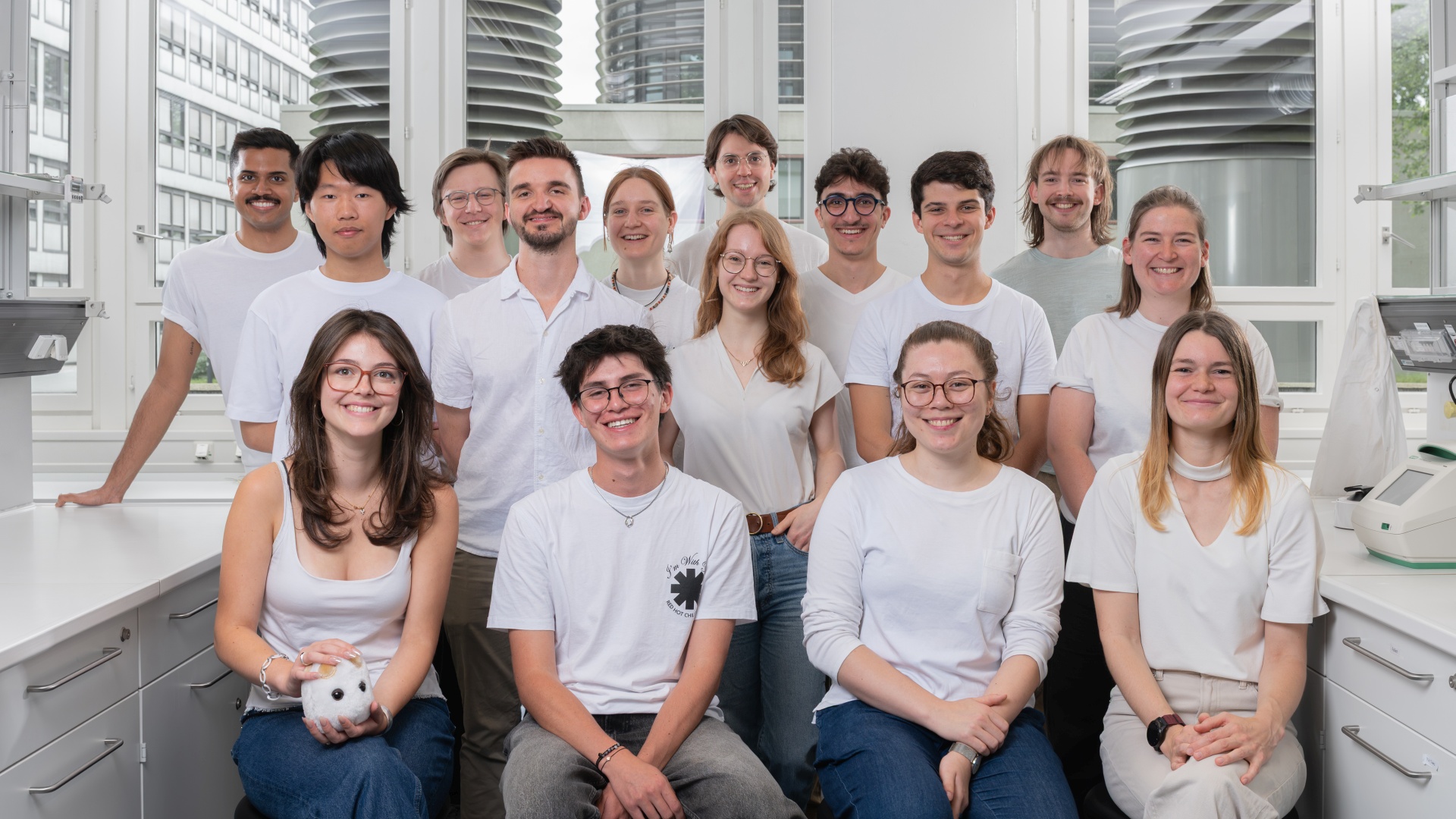
Through the project, they also get to explore topics that are not covered in depth during their studies. “In the software group, we are currently programming in Python and JavaScript,” says Friederike. “It is great to build on these practical skills through iGEM and not limit ourselves to just the course material.” Nevertheless, the 16-member team makes sure that the time commitment is balanced among the individual members.
“There is a lot to do, and we communicate with each other about how much capacity every person has,” says Thomas. They also receive support from KIT’s Institute of Bio- and Food Technology: Professor Dirk Holtmann and Lukas Platz – who supervises the team and, based on his own positive experience with the competition, advocated for KIT’s participation – are key contacts for the students.
In synthetic biology, researchers deliberately intervene in biological systems to modify them. “To do this, they use building blocks from nature, such as DNA,” explains Friederike. “They then modify these so that organisms receive new properties.” In its project, the team is working with yeast that produces protein shells. “We modify these protein shells so that they encapsulate molecules,” says Karoline. “At the same time, they act as enclosed reaction chambers that are protected from the outside – this allows us to carry out enzymatic processes within them.”
The goal is to use mRNA – a messenger molecule that contains genetic information for building proteins – as a basis for developing additional analytical methods to study yeast’s stress response. “Ultimately, we’re building a molecular biology toolbox that we can pass on to future teams and use to conduct applied basic research,” adds Karoline. In this way, the team aims to help optimize biotechnological processes in industry.
Part of the competition involves promoting their own research project through software programming, public relations, and social media posts. The team also had to secure sponsors, as participation is self-funded. All of this also creates a special sense of community – both within the team and through interactions with other teams.
“Our group is an open space where people come together who would otherwise never meet during their studies,” says Thomas. Plus, iGEM will always be open to you in the future: “You can participate every year,” adds Karoline. “You benefit from the community and the international network for a lifetime.” As iGEM enters its second round next year, the three are already looking forward to exciting projects and a team for whom the, above all, the journey itself is already the true goal.
Elisa Rachel, June 25, 2026