How did you like the article? Feel free to use our new rating feature on the right edge of the screen and let us know what you think! This will help us improve our content.
Participation is voluntary and anonymous.


The cost-effective use of alternative, sustainable energy sources is playing an increasingly important role. Tenure-track professor Johanna Schröder focuses on renewable hydrogen production and explains how essential this process is for sustainable energy storage.
How did you like the article? Feel free to use our new rating feature on the right edge of the screen and let us know what you think! This will help us improve our content.
Participation is voluntary and anonymous.
Mrs. Schröder, how important is affordable hydrogen for the energy transition?
Affordable hydrogen is a key component of the electrification of the chemical industry and, consequently, of the energy transition. While fossil fuels, which currently cover a large portion of our energy needs, are finite, renewable energy sources such as sunlight and water are available indefinitely but do not provide a constant supply of energy. This raises the question of how we can store excess electricity and balance out periods of low generation.
Green hydrogen, which can be produced using renewable energy via electrolysis – that is, the splitting of water into hydrogen and oxygen – represents a key form of energy storage. Hydrogen has a wide range of applications, such as in ammonia production, fuel cell vehicles, and as a substitute for coal in steel production.
Since the hydrogen used to date has primarily been a byproduct of petroleum processing, the use of renewable hydrogen is desirable in all these applications. This requires cost-effective production to economically replace fossil-based hydrogen. Researchers around the world are already working on alternatives to the use of ultrapure water, more efficient electrolyzers, as well as on their scalability, so that green hydrogen can be made available at a low cost as a central component of the energy transition.
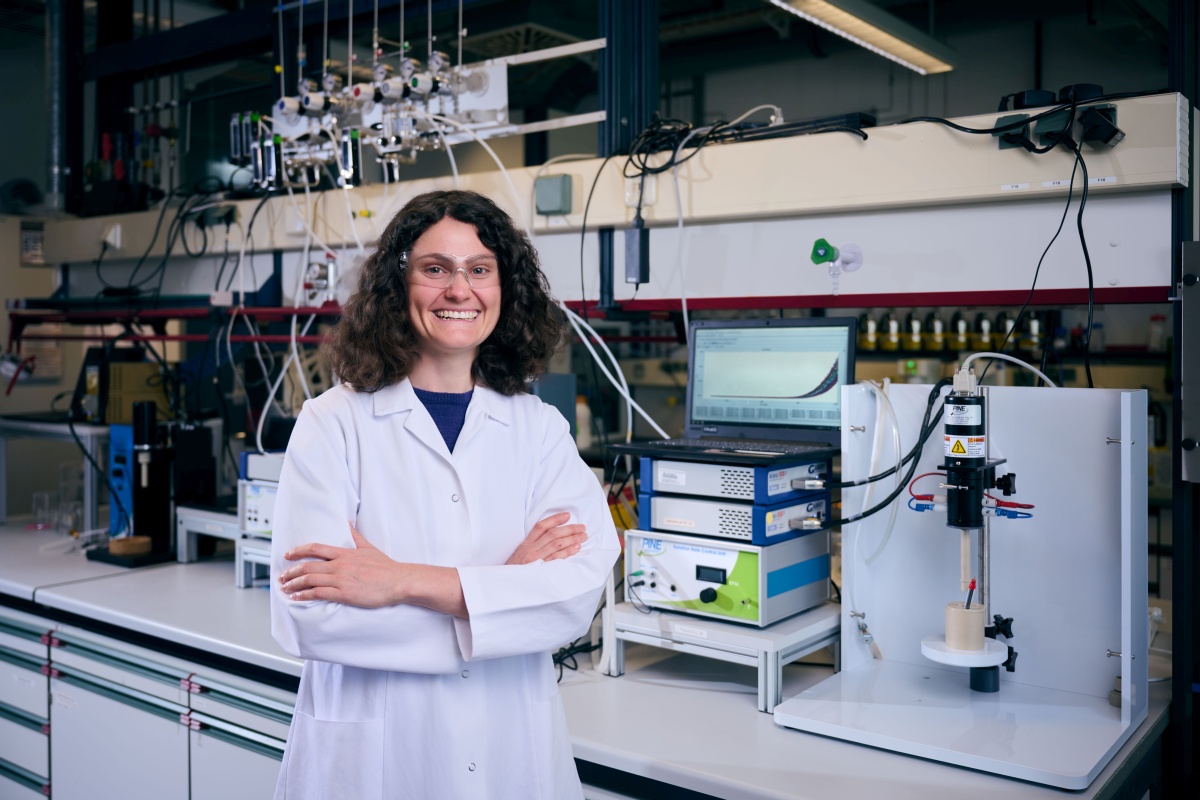
About the Person
After completing her studies and earning her Ph.D., Johanna Schröder conducted research as a postdoctoral fellow at Stanford University. In 2025, she joined KIT as the head of a CZS Junior Research Group, and since December 2025, she has been a tenure-track professor at the Institute for Applied Materials – Electrochemical Technologies at KIT.
Do you also have a “good question” about a research topic? Feel free to send it to clicKIT-Magazin∂km.kit.edu!
Lea Laraia, August 20, 2026